Second Life Mobility · a venture of Energypreneurs Advisory
The jeepney doesn't need replacing. It needs a new engine.
There are around 300,000 traditional jeepneys in the Philippines, burning about US$1.1 billion of imported fuel a year — about US$3,600 each. Replacing them one by one would cost US$10 billion and take more than twenty-five years at the current pace. We convert the vehicle instead — certified electric drive at under half the cost of a new unit, paid for out of the diesel it stops burning.
Fleet size and fuel spend: fleet and convertibility assumptions from CPBRD Policy Brief 2020-02, House of Representatives, Philippines. Annual fuel spend is derived — roughly 300,000 vehicles at about US$3,600 of diesel each gives US$1.1 billion. Conversion and new-unit costs are Second Life Mobility estimates at certified specification.
Why replacement has stalled
Modernisation has relied on operators buying a new electric unit at around US$40,000. For a jeepney cooperative earning fare revenue, that number does not work — and cooperatives that borrowed to try are now defaulting on their loans.
The result is a programme with more than twenty-five years still to run at its current pace, while the diesel bill compounds behind it. Replacing the whole fleet would cost around US$10 billion.
Conversion changes the arithmetic. It keeps the body the operator already owns, costs about US$18,000 against US$40,000 for a new unit, and — critically — repays itself from fuel savings inside the vehicle's remaining life.
It also reaches the operators that the replacement path will not serve for decades. This is completion of modernisation, not competition with it: a converted unit delivers the same zero-tailpipe outcome the programme has sought since 2017.
The economics, per vehicle
All figures in US dollars, per jeepney, per year.
Diesel today
About US$3,600 a year in fuel, almost all of it imported.
Running on grid electricity
About US$1,900 — a saving of US$1,700, or 47% lower.
Half solar, half grid
About US$1,450 — a saving of US$2,150, or 60% lower.
Conversion runs between roughly US$13,000 and US$20,000 against US$40,000 for a new electric unit — a third to half the cost, depending on the retrofit specification. The national programme is modelled at US$18,000 per vehicle, at certified specification. A battery-as-a-service option moves the single largest cost component off the upfront price into a monthly fee paid out of the fuel saving. Add solar to the charging and the operating cost falls by 60 per cent — which is what makes the conversion repay itself inside the vehicle's remaining life. A US$40,000 replacement unit never repays on jeepney fares.
How it works
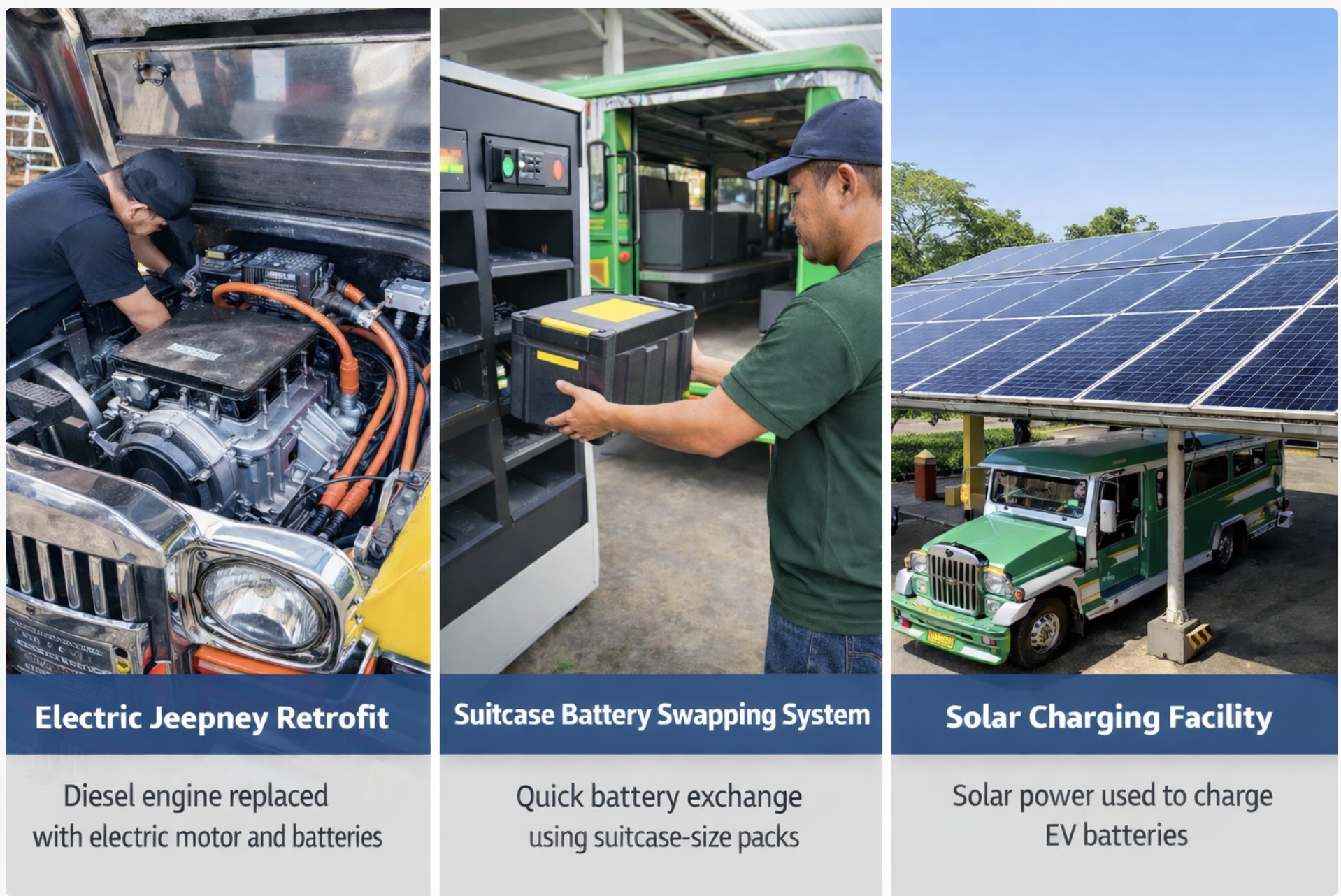
Three parts, one system
The conversion on its own is not the product. A jeepney that has to stop for four hours to charge has been made worse, not better. The drivetrain, the battery swap and the solar charging are one system, and each part exists because of the other two.
The drivetrain
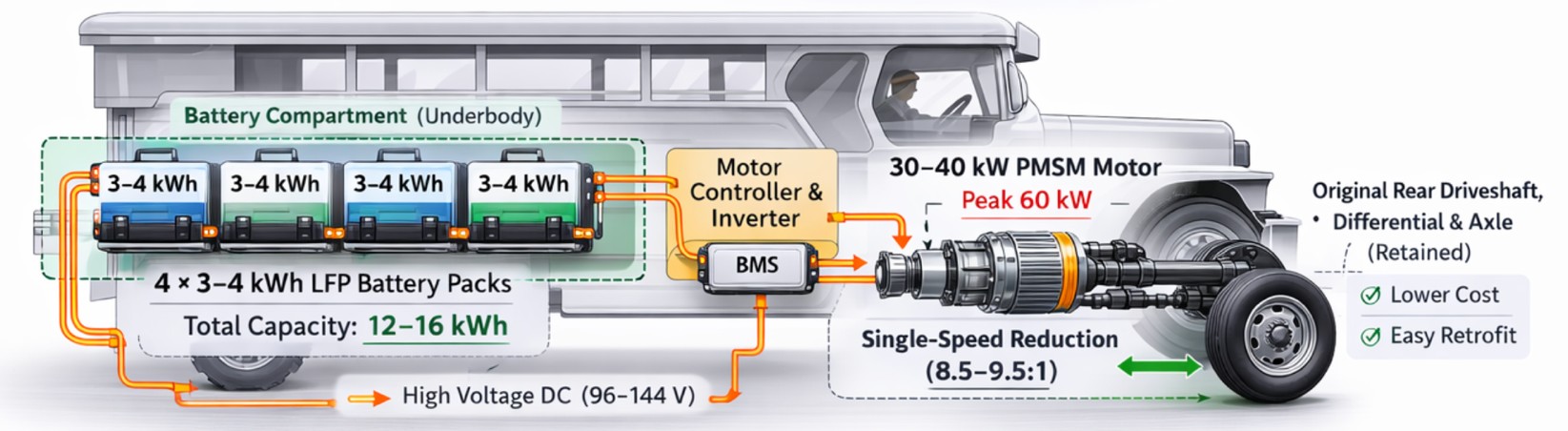
A 30–40 kW permanent-magnet motor with a 60 kW peak, driving through a single-speed reduction into the original rear driveshaft, differential and axle. Keeping the existing driveline is what makes the retrofit cheap and quick. Four LFP battery packs of 3–4 kWh sit in an underbody compartment, 12–16 kWh in total, at 96–144 V DC.
The numbers that matter to a driver
Each pack weighs 18–25 kg and is swappable in under two minutes, which is the number that matters to a driver: the vehicle is off the route for the length of a swap, not for the length of a charge. Range per pack and daily duty cycle are being confirmed on the pilot vehicles and will be published once measured rather than modelled.
Why swapping, not charging
A jeepney earns money by moving. Charging in place means hours off the route in the middle of a working day, which is precisely when the vehicle is worth the most. Swapping turns a four-hour problem into a two-minute one — and it separates the battery from the vehicle, so the driver never has to finance the most expensive component.


The national argument
Two paths, one goal
The country does not have to choose between modernising and waiting. It has to choose between buying a new fleet and upgrading the one it already owns — and the second is the same logic the power sector has applied for decades.
We extend the life of coal plants. We convert open-cycle gas to combined-cycle. We rehabilitate hydropower on the same dam. In every case the asset still has value, the upgrade is cheaper than replacement, and you do not wait twenty-five years to start saving. The jeepney is the same asset class with a shorter chassis.
Path 1 — buy all new
~US$10 billion to replace the fleet outright. At the programme's current execution speed that is 25 years or more, during which the fuel import bill stays where it is. Cumulative saving over the twenty years to 2052: around US$5.5 billion.
Path 2 — convert what can be converted
~US$4.5 billion, reaching half the fleet within ten years (2027–2036). Savings begin in year one rather than year ten. Cumulative saving to 2052: around US$10 billion — roughly double, for under half the capital.
Not every jeepney should be converted. About half the fleet is young enough to justify it today. The other half is too old, and should be replaced with new electric units as those reach price parity around 2036. Convert the half that makes sense now; replace the rest later. That is the whole proposal.
The proposal: prove it with 20,000
Fleet-size and convertibility assumptions drawn from CPBRD Policy Brief 2020-02, House of Representatives. Conversion cost ~US$18,000 per vehicle against ~US$40,000 for a new electric unit.
See it working
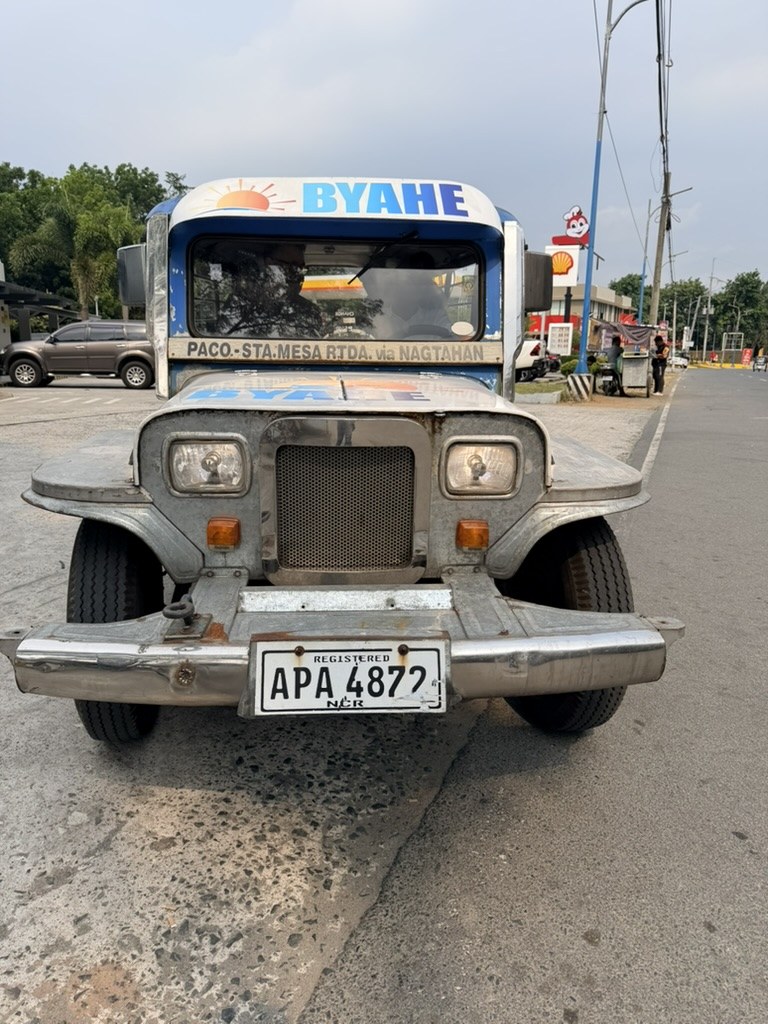
A retrofitted jeepney on the road in Manila. Same body, same 23-passenger capacity, same route — Paco to Sta. Mesa via Nagtahan — without the diesel engine.

Why this photograph matters
The conversion argument is easy to dismiss as theoretical until you see the vehicle. This is a working jeepney — rust, dents, a body that has carried passengers for decades — with an electric drivetrain where the diesel engine used to be. Capacity unchanged at 23 passengers. Route unchanged. Registration unchanged.
That is the whole proposition in one frame. The operator keeps the asset, the route and the licence. What changes is the thirty litres of diesel a day.
Inside a converted jeepney
LFP battery packs mounted under the floor, electric motor and controller in place of the diesel engine, original driveshaft and axle retained. Lower cost, faster retrofit, and a drivetrain the local mechanic trade can be trained to maintain.
Converted units charge from rooftop solar at cooperative garages, or from solar walkways along side roads, deployed case by case with each local government unit.
Footage from the road is being prepared and will be added here shortly.
Certified, not improvised
Informal conversions are already happening in the Philippines. Some have battery packs mounted in the front cabin, with no crash standard, no thermal management and no fire protection. That is the alternative to a regulated pathway, and it is already on the road.
Second Life Mobility works to a certification regime built on ISO 26262 functional safety, defined battery placement and active thermal management. Our proposition to government is a supervised national standard — one that replaces a grey market rather than pretending it does not exist.
The team
Laurence Bahia
Co-founder & COO, Philippine operations. Previously of eSAKAY, one of the country's pioneering e-jeepney operators.
Reah Sy
Policy and communications. Formerly of the Asian Development Bank and the International Monetary Fund.
Sohail Hasnie
Founder & CEO. Architect of ADB's US$500 million Philippine e-trike programme — the precedent this work builds on.
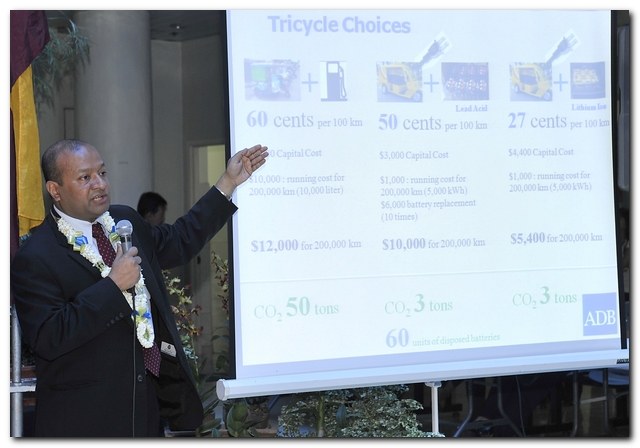
The argument has not changed, only the vehicle
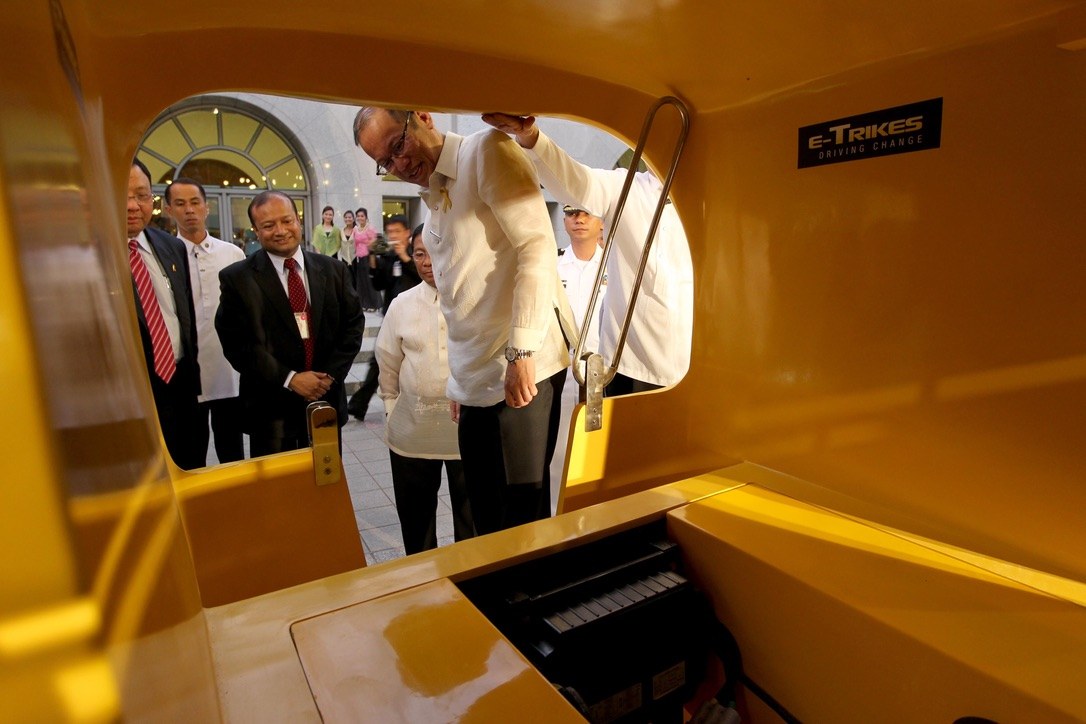
Sixteen years ago the case for electrifying Philippine three-wheelers was made on the same arithmetic we now apply to jeepneys: cost per hundred kilometres, capital outlay, battery replacement over the life of the asset, and tonnes of CO2 either way. Lithium won on total cost, not on sentiment.
That analysis became a US$500 million national programme. Conversion is the same calculation applied to a vehicle that already exists.
Conversion engineering is anchored by JeepneyX. Technical depth is drawn from established international conversion specialists.
Beyond the jeepney
The jeepney is the entry point, not the end point. The same certified platform — factory, engineering standards, financing model and charging infrastructure — extends across the country's diesel fleet.
Boats and ferries
Inter-island transport running on heavy diesel.
Trucks and buses
Freight and long-haul passenger fleets.
Taxis and UV Express
Predominantly Toyota and Mitsubishi platforms.
Heavy equipment
Cranes and dredgers operated by public agencies.
Each shares the same logic: the vehicle body outlives its engine, and conversion captures that remaining life at a fraction of replacement cost. A conversion industry established now becomes the industrial base for electrifying the Philippine fleet as a whole.
None of this is exotic
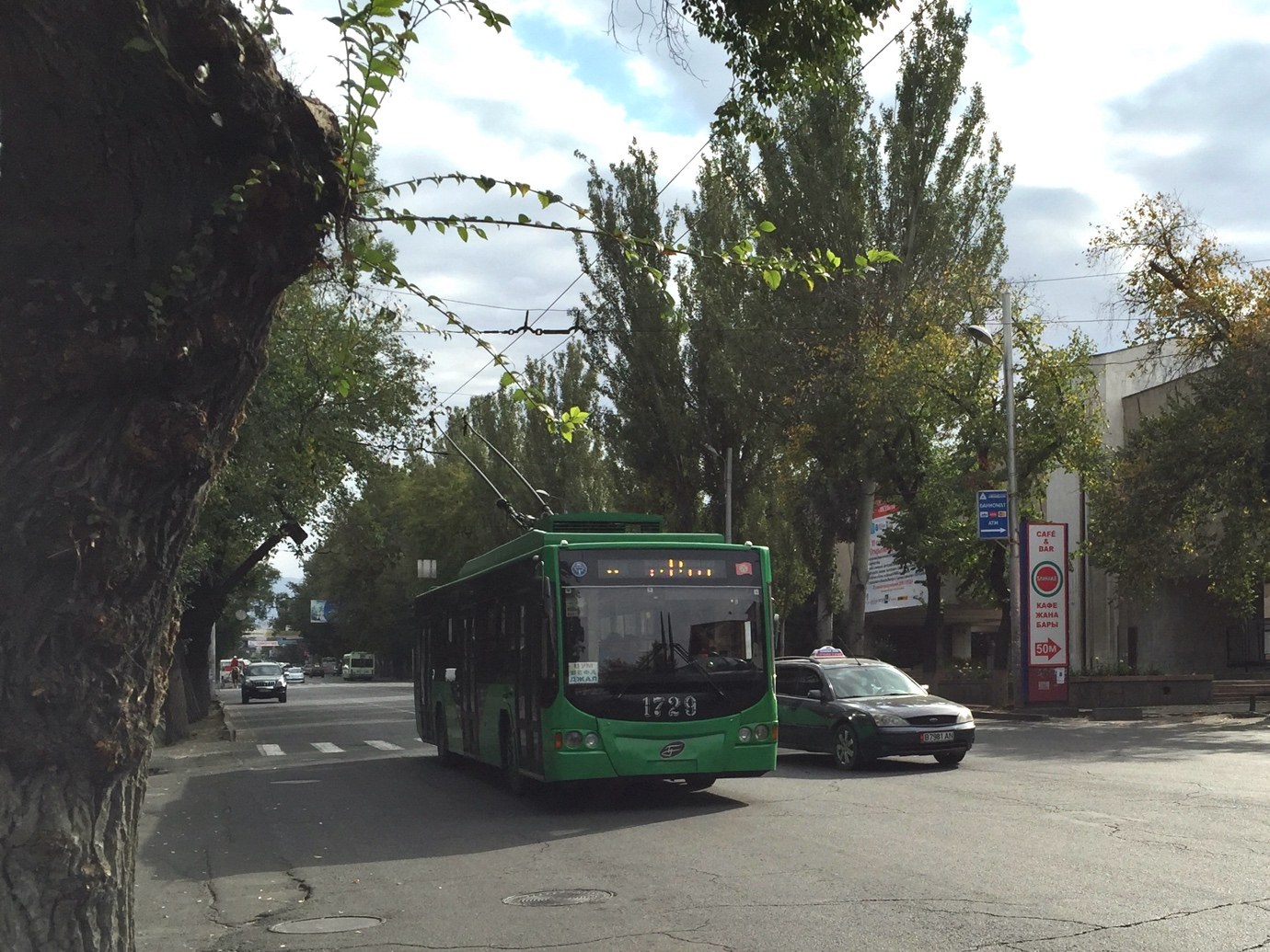
Electric public transport is not a new idea waiting to be proven. Bishkek has run trolleybuses for decades, on a grid far less robust than Manila's, in a country with a fraction of the Philippines' economy. The question was never whether electric public transport works. It is who pays for the vehicle, and how.

Talk to us
We work with operators and cooperatives, local government units, investors and national agencies. Tell us which of those you are and what you want to understand.
Second Life Mobility is a trading name of Energypreneurs Advisory Pty Ltd, an Australian company. Level 15, 500 Bourke Street, Melbourne VIC 3000.